
From Democratic Recession to a Human Rights Renaissance: Reimagining a New Tomorrow: The Perspective of the Ombudsman
Published October 23, 2026
From Democratic Recession to a Human Rights Renaissance: Reimagining a New Tomorrow: The Perspective of the Ombudsman
Published October 23, 2026
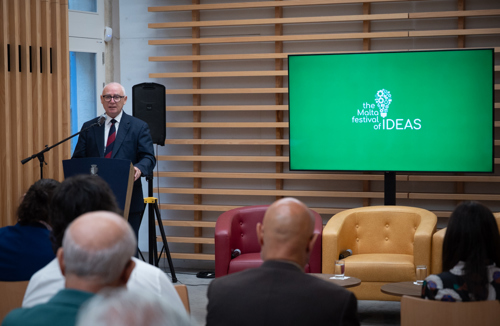
The Parliamentary Ombudsman, Judge Joseph Zammit McKeon, delivered a keynote address entitled “From Democratic Recession to a Human Rights Renaissance: Reimagining a New Tomorrow: The Perspective of the Ombudsman” at the opening of a two day conference held as part of the Malta Festival of Ideas, organised by the Culture Directorate.
The opening session was also addressed by the Minister for Arts, Culture and National Heritage, the Hon. Malcolm Paul Galea, and the Director of Culture, Alexander Farrugia.
The Malta Festival of Ideas reflects the Culture Directorate’s commitment to encouraging creativity, innovation and positive change across the artistic and cultural sectors. Inspired by Edward de Bono’s long term vision of Malta as a hub for creativity and innovative thinking, the Festival brings together different disciplines and perspectives to reflect on contemporary challenges and explore more sustainable and harmonious futures.
Through its emphasis on creativity, transformation and collective action, the Festival also recognises the importance of drawing on knowledge, practices and philosophies from the past while considering how these can contribute to shaping the future.
The full text of the Parliamentary Ombudsman’s keynote address follows:
From Democratic Recession to a Human Rights Renaissance:
Reimagining a New Tomorrow: The Perspective of the Ombudsman
Speech by the Parliamentary Ombudsman, Judge Joseph Zammit McKeon
We are familiar with the term “recession” when it is associated with the performance of an economy: falling GDP, rising unemployment, lower consumer spending, reduced business investment, low productivity and declining industrial production.
In contrast, the “renaissance” was the major cultural, intellectual, artistic, and scientific movement that began in Florence in the 14th century and later spread across Europe, as a reaction to the Medieval world. It is associated with rebirth of reason, education, artistic innovation, science: Leonardo da Vinci, Michelangelo Buonarroti, Raffaello Sanzio, Galileo Galilei.
Darkness
Simply thinking about “democratic recession” is a challenge in itself. The term reminds me of a news-stand display of February 2017 when the “Washington Post” stated: “Democracy Dies in Darkness.” Top of FormBottom of Form
Today, much more than in the past 30 years, use of the phrase “democratic recession” should shake public opinion. We witness worldwide that trust in public institutions that has become weaker. We experience more division in public debate. Speaking of rights is treated as an inconvenience or worse. International co-operation is increasingly fragile and one-sided in favour of the strong. Fake-news travels faster than reason and the truth. There are people in good faith who feel unheard, others feel excluded, others forgotten, others put aside or who are becoming worse off every day.
Humiliation
Speaking about the present.
Human humiliation in all its forms is not a relic of the past. It is a reality of our time and has taken forms that go beyond borders and cultures. Because humiliation destroys hope, we have an obligation to affirm human dignity — the inherent worth belonging to every person, regardless of who they are, what they have, what they believe or where they come from.
To humiliate is not simply to disagree with someone, criticise or hold accountable. Humiliation goes much further. As it devalues the person, humiliation inflicts wounds. that are difficult to heal, not impossible but difficult, because a person deprived of dignity begins to lose hope, and when hope is lost, despair takes over.
Slavery, persecution, discrimination, systematic degradation of entire populations are still the order of the day. Memorials have been built and the promise is repeated: never again. Nonetheless people continue to be shamed because of war, poverty, disability, ethnicity, religion, origin, age, gender or social condition. Migrants and refugees are considered burdens. Older people experience neglect. Children experience bullying that destroys their self-worth. The poor are made to feel ashamed simply because they require assistance.
Today degradation has a powerful new instrument: technology. A person's mistake can be recorded, circulated and preserved indefinitely. Ridicule can reach thousands within minutes if not seconds. Online anonymity can release a degree of cruelty that many do not have the courage to display face-to-face.
The means have changed. The injury remains intact.
Dignity is not a privilege acquired through wealth, education, nationality, social status. There is little moral achievement in respecting only those whom we admire. The deeper test is whether we are able to accept persons whose conduct we reject, whose beliefs we oppose or whose circumstances are entirely different from our own.
A society reveals much about itself through its treatment of people who possess the least power. The powerful rarely struggle to make themselves heard. The vulnerable do : those who, for whatever reason, stand at the margins rather than the centre of society. A society where the strong advance while the vulnerable are forgotten cannot genuinely claim to serve the common good. A society that values economic advancement while accepting human degradation has misunderstood progress.
Questions
Despite the negativity that we witness, history has thought that periods of democratic crisis can kick-start democratic renewal.
But we have to ask crucial questions and look for answers.
What kind of democracy do we want?
What kind of society do we want?
The common good requires that we move from democratic recession to a human rights renaissance. Not mere survival, but renewal grounded in dignity, justice, accountability and the rule of law.
To help reflection, you may wish to read an article written by Jacopo Fo published on the 9 October 2026 in the online edition of La Repubblica entitled "Dario Fo, San Francesco e quella rivoluzione della gentilezza che ancora ci serve".
Erosion
Democratic decline rarely comes about dramatically. It often advances gradually but steadfastly by accepting as normal and unavoidable: intolerance, unclear decision-making, hostility towards dissent, indifference towards the suffering of others.
The “killing of dialogue” and “the killing of solidarity” are expressions used by Professor Elzbieta Matynia of the New School in New York and founding director of the Transregional Centre for Democratic Studies in a keynote address she delivered on the 26 Jan 2018 to explain the consequences of democratic recession (or worse : erosion), situations of fact that are liable to emerge when institutional fatigue prevails, when people begin to feel that injustice is inevitable and that institutions cannot improve. The real strength of democracy is when the public believes that public offices have a duty to respect the rights of the many.
Much more
Democracy is much more than a free and fair electoral process.
Democracy cannot be reduced solely to elections.
Although free elections are indispensable, democracy does not end when ballots are counted and results are public. A democracy must also be judged by the way authority is exercised between elections and how institutions treat persons when they engage with the State.
The State may possess sophisticated constitutional structures and yet fail in the administration of justice and in the provision of public services, which is what matters most in the lives of people. For many, democracy is not a textbook. It is expected to be daily life experience in hospitals, schools, prisons, authorities, social services departments, police stations, tax offices and immigration systems and so forth.
When the exercise of discretion by public authorities becomes arbitrary, unfair, indifferent, improperly discriminatory, people question the democratic process itself and what it really represents. Democracy fails without good governance because democracy in action is not another slogan. Transparency, accountability, responsiveness, fairness and respect for human dignity are not optional administrative virtues. They are democratic imperatives.
Compass
The observance of human rights is the moral compass of democratic governance. Even human rights are not abstract ideals or lecture topics for academics. Their observance and application determine and ensure that a child receives education without being discriminated for any reason, that an elderly person is treated with respect, that the sick are treated with dignity when they receive care and treatment in public hospitals, that prisoners are considered holders of rights save for their freedom, that migrants are not considered as threats to a life of apparent comfort, that persons with special needs enjoy equal treatment and participation, that people can speak freely without fear of reprisals of any sort.
The protection of human rights is not an obstacle to democracy in practice but constitutes its ethical foundation. A democracy that cares less about human rights ultimately weakens itself because the modern human rights framework is not the result of textbook idealism, but human tragedy being the aftermath of war and persecution. Although the central message remains timeless: “never again”: the message is not a matter to be taken for granted. Each generation must defend it anew.
The Ombudsman
Efficiency is good. Legality as well. However, when detached from justice, both they risk becoming a paper exercise. Legality alone does not always guarantee justice. An action may comply technically with legal rules while still produce outcomes that are unreasonable, oppressive or unfair.
Public institutions exercise authority that people do not have. However, with authority comes responsibility. Government decisions affect livelihoods, opportunities, property, health, education, liberty and countless aspects of daily life.
Legality should never become an excuse for indifference. Procedure is necessary, but procedure should facilitate justice rather than obstruct it. Efficiency matters, but a system cannot properly be called efficient if it processes cases rapidly but treat people without dignity. This is where independent oversight institutions like the Ombudsman assume relevance.
There is an important matter that laws alone cannot provide. We need to care. Modern societies rightly invest enormous effort in improving efficiency, productivity, technological capacity and economic performance. But a although a society may become more prosperous, it needs to be more caring. A community may communicate faster while listening less. It may accumulate extraordinary knowledge while losing wisdom. Care must therefore return to the centre of our understanding of social progress. Caring includes giving attention to people that the majority may be tempted to overlook. It means refusing to regard another person's suffering as the problem of somebody else not my own. It means understanding that compassion is not weakness.
In this environment with in-built challenges, the Ombudsman occupies a special constitutional and moral role. The Ombudsman is an institution that goes beyond legal intricacies and looks out for maladministration. The institution strives to uphold the rule of law within a framework of fairness and accountability in public administration.
The Ombudsman represents a model of democratic accountability grounded in persuasion, which is by far not a weakness.
When moral authority is exercised with integrity and independence, it constitutes one of the most distinctive features of democratic life.
An Ombudsman who investigates with impartiality, acts with prudence, and speaks out without fear contributes to re-affirm public confidence.
Many approach the Ombudsman when they feel powerless elsewhere.
That is why the institution performs a vital democratic function, as it reassures people that they matter because they are visible holders of rights. Rather than confrontation, people seek understanding, fair treatment and recognition of their dignity.
Public administration is increasingly complex, technological and data driven. Decisions affecting persons may be made through uncertain and contradictory procedures or automated systems that embody risk to the dignity of the person. In such an environment, independent and impartial institutions that are capable of examining the human consequences of public administrative action become indispensable.
The institution actively pursues respect which begins when a person is valued and not treated as an item of social expenditure.
Renaissance
Medieval times in their early part were known as the Dark Ages. As a whole the Middle Ages lasted one thousand years. Then came the Renaissance. The rest is known.
The question:
Today do we require another Renaissance of values at least as far as the promotion and protection of human rights in concerned?
If we are to move beyond democratic recession, societies must embrace not simply institutional repair, but democratic renewal.
How?
First, by rediscovering the universality of human dignity. Human rights cannot become selective. They cannot depend upon political convenience or ideological preference. The true test of a democracy lies not in how it treats and manages the powerful, but in how it treats the forgotten, the vulnerable and the sidelined.
Second, a human rights renaissance requires rebuilding trust between institutions and the people. Trust cannot be demanded. It must be earned through transparency, accountability and ethical conduct. Public institutions must demonstrate that they are willing to listen, explain and correct mistakes. Humility in governance is wisdom not a weakness.
Third, Democracy depends not only on institutions, but on people capable of dialogue, empathy and critical thought. A society saturated with hostility and permanent outrage risks losing its democratic soul. Disagreement is natural within a democracy but reducing people to numbers should never become normal.
Fourth, a human rights renaissance requires courage. There are moments when institutions must speak clearly against injustice, discrimination and abuse of power. An Ombudsman must remain impartial, but impartiality does not mean silence in the face of systemic unfairness.
Fifth, the rule of law as the operating system of democracy. The fair and non-discriminatory application of law that protects people from arbitrary behaviour by the State and protects democracy from degenerating into raw power. Yet the rule of law also depends upon a culture of resolve. Laws alone cannot sustain democratic integrity if institutions put aside ethical responsibility, or if communities become indifferent to injustice. Defence of the rule of law therefore requires constant vigilance.
Through its commitment and action, the Ombudsman contributes towards a culture of principled oversight rooted in fairness and reason.
Sixth, a renaissance is not credible without care for the vulnerable because a community reveals its true worth by caring for those persons who have the least power. One of the gravest risks during periods of democratic stress is that vulnerable groups become invisible.
The Ombudsman institution must remain attentive to those whose voices are weakest.
Hope
Systems of conduct in the public administration cannot be allowed to become so impersonal that human distress is reduced to statistics or files.
Democracies cannot survive without hope. Hope is not a synonym of naïve. It is a conviction that society is capable of improvement. Even the evolution of human rights itself is a history of hope. Every major democratic push forward became a reality because people simply refused to accept injustice as inevitable.
Conclusion
The future of democracy cannot be secured by constitutional texts, algorithms or political rhetoric.
It will depend upon whether societies continue to believe in the dignity of the person.
It will depend upon whether institutions retain moral courage.
It will depend upon whether people insist that justice, fairness and accountability remain non-negotiable democratic values.
An oversight institution including the Ombudsman cannot be the solution for everything.
But the Ombudsman can help the public to remember the essentials.
In times of democratic recession, independent institutions have become even more important.
The move from democratic recession to a human rights renaissance is not an easy one.
Nonetheless history has repeatedly proved that renewal is possible whenever societies choose conscience over indifference, dialogue over hatred, justice over arbitrariness and humanity over fear.
We must do our share to imagine a tomorrow founded not upon division, exclusion or democratic fatigue, but upon solidarity and justice.
We must aspire for a tomorrow where public authorities listen, where rights are promoted and protected, where governance serves humanity rather than the reverse, where the forgotten do not remain without a voice, where the rule of law is a lived reality rather than a slogan.
One very last observation.
What I have stated is not rhetoric but my living concern for a world that I want much better than it is at present.
