
Council of Europe publishes manual on human rights and artificial intelligence
Published April 15, 2026
Council of Europe publishes manual on human rights and artificial intelligence
Published April 15, 2026
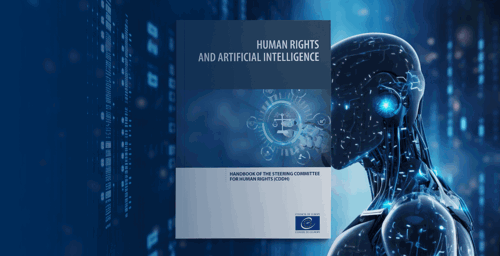
The Council of Europe Steering Committee for Human Rights has published a Manual on Human Rights and Artificial Intelligence, providing practical guidance on how public authorities should design and use AI systems in line with human rights standards.
The Manual is grounded in the European Convention on Human Rights and the European Social Charter and complements the Council of Europe’s Framework Convention on Artificial Intelligence, Human Rights, Democracy and the Rule of Law. It focuses in particular on the use of AI within public administration and the safeguards required to ensure that technology serves people while respecting their fundamental rights.
The document sets out a clear framework to guide national authorities in the responsible use of AI. It emphasises that the deployment of AI in public services must remain firmly anchored in the rule of law, with public authorities retaining full responsibility for decisions taken, even where these are supported by automated systems.
Central to the Manual are key principles that must underpin the use of AI. These include legality, respect for human dignity, non-discrimination, transparency, accountability, and the need to ensure safety and security. The Manual stresses that individuals must be able to understand how decisions affecting them are made and must have access to effective remedies where their rights are impacted.
A strong emphasis is placed on human oversight. AI systems should support decision making but must not replace human judgment. Public officials are expected to retain meaningful control and must be adequately trained to assess and challenge AI outputs where necessary.
The Manual also promotes a risk-based approach, encouraging authorities to identify and assess the potential impact of AI systems on fundamental rights. Systems that pose higher risks require stronger safeguards, including impact assessments, monitoring mechanisms, and independent oversight.
The guidance further highlights the importance of sound data governance, including data quality, accuracy, and protection, as well as the need to embed ethical and legal safeguards in procurement processes.
The principles set out in the Manual reflect positions consistently highlighted by the Parliamentary Ombudsman, Judge Joseph Zammit McKeon. In his public interventions on artificial intelligence and human rights, the Ombudsman has repeatedly stressed that AI does not fall outside the rule of law and must therefore function in full respect of human rights.
The Ombudsman has also emphasised the importance of human oversight, noting that decisions impacting people’s lives cannot be left to automated processes alone. He has called for clear accountability mechanisms and safeguards to ensure that persons have access to redress when harm occurs.
The publication of this Manual provides timely and practical guidance for public administrations. It reinforces the principle that technological innovation must go hand in hand with the protection of fundamental rights and the strengthening of good governance.

