
Parliamentary Ombudsman presents first Ombudsman Prize in Law
Published February 17, 2026
Parliamentary Ombudsman presents first Ombudsman Prize in Law
Published February 17, 2026
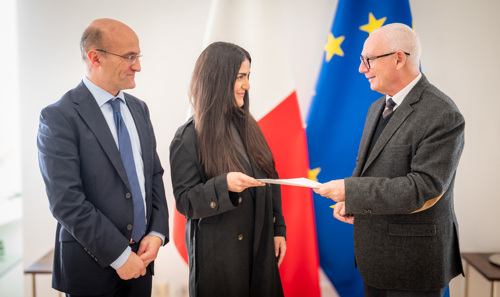
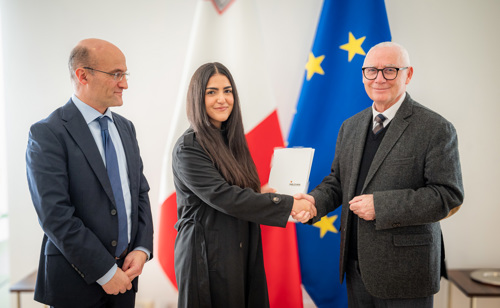
The Parliamentary Ombudsman, Judge Joseph Zammit McKeon, presented the first Parliamentary Ombudsman Prize in Law to Ms Jodie Mary Farrugia in recognition of her dissertation titled ‘Guardian of Good Governance: Expanding the Jurisdiction of the Parliamentary Ombudsman in Malta’, submitted in April 2025.
The dissertation was acknowledged by the Faculty of Laws of the University of Malta as achieving a good academic standard and as a meritorious contribution within the scope of the prize. Present for the presentation was Professor Ivan Mifsud, Dean of the Faculty of Laws.
The Malta Parliamentary Ombudsman Prize in Law aims to encourage research and the dissemination of knowledge on subjects related to the Parliamentary Ombudsman and the principles of good administration and governance. Through this initiative, the Office promotes academic engagement with the institution and fosters continued interest in the protection of citizens’ rights within public administration.
In his remarks, the Ombudsman congratulated the awardee and expressed appreciation for her contribution to the study of the Ombudsman institution. He noted that the prize is intended to encourage students to pursue research related to oversight institutions and their role in strengthening accountability and fairness in public administration.
The study examines whether the jurisdiction of the Parliamentary Ombudsman should be expanded to address contemporary governance and human rights challenges. It focuses on two principal issues: the oversight of private entities that provide essential public services and the possible conferral of a formal mandate for the protection and promotion of fundamental rights.
The first part analyses the effects of privatisation on administrative oversight. It argues that the current definition of public authority in Maltese law is restrictive because it excludes private bodies performing functions of a public nature. Drawing on comparative legal models, particularly the broader interpretation adopted in the United Kingdom and the French concept of public service, the research proposes legislative reform to ensure that such entities fall within the Ombudsman’s jurisdiction. Maltese jurisprudence and previous academic proposals are also examined in support of these conclusions.
The second part studies the absence of an explicit human rights mandate within the present legal framework governing the institution. It reviews national proposals to designate the Ombudsman as Malta’s National Human Rights Institution in line with the Paris Principles. The dissertation considers alternative models and favours the proposal that integrates a comprehensive human rights mandate directly within the statutory role of the Ombudsman.
The study concludes that expanding the jurisdiction of the Parliamentary Ombudsman is necessary to respond to evolving public expectations, strengthen accountability in contexts where public services are delivered by private entities, and align Malta’s institutional framework with international human rights standards.
The full dissertation is being published for public access as part of the Office’s commitment to research and public discussion on good governance and the role of independent oversight institutions.

